When Desperation Meets Disinformation
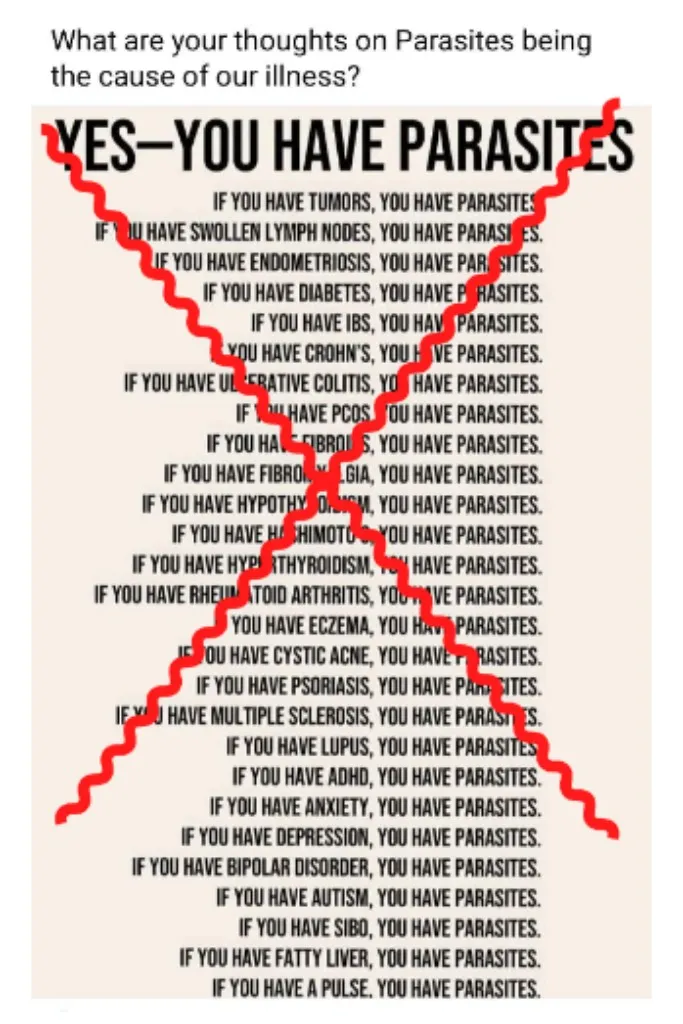
It started with a meme—black text on a beige background, listing dozens of conditions: tumors, diabetes, fibromyalgia, ADHD, depression, autism. Every line ended the same way: You have parasites. And just in case anyone was left out, it closed with the catch-all: If you have a pulse, you have parasites.
It was absurd. But it stuck.
The meme spread—not despite its absurdity, but because of it. It was outrageous, meme-able, impossible to ignore. Easy to mock. But its appeal is no joke. It offers something powerful: a clear, external cause for complex, painful, often invisible health struggles. Something to blame. And just as importantly, a promise—of control, of cleansing, of cure.
This kind of disinformation doesn’t spread because people are stupid. It spreads because people are suffering.
Chronic illness is often isolating, invalidating, and poorly understood by both medicine and society. People with autoimmune conditions, neurodivergence, or chronic pain are frequently dismissed or misdiagnosed. They’re told it’s all in their heads. They cycle through medications that don’t work. They’re blamed for their symptoms. Meanwhile, public health messaging speaks in declarations. Authority speaks in absolutes. And the media that filters this information offers even less nuance.
Into this void steps the parasite meme. It appeals to truth-adjacent feelings: that something is deeply wrong, that the system is bad (or worse—self-serving and evil), and that maybe the answers lie somewhere else. It casts suspicion on the body itself. Instead of shame, it offers an explanation—and more importantly, a solution.
That’s the hook.
Of course, the medical claim is false. Despite the fact that some parasites can cause disease, the vast majority of people with the listed conditions do not have harmful parasites. But the meme works because it layers a half-truth over a legitimate grievance. We do, in fact, host vast networks of life within us: bacteria, viruses, fungi, and yes, helminths. And those organisms—collectively called the microbiome—are essential for our health.
We might even go further and speak of a superbiome: the full ecosystem of human and non-human life that coexists and co-regulates within and on us. Our immune systems evolved in constant conversation with these co-inhabitants. Some, like therapeutic helminths, may even be beneficial in treating autoimmune conditions—a fact that complicates the meme’s message further. The human organism evolved with them and they are an integral part of maintaining the homeostasis of the immune system.
But this is the problem. Complex truths don’t go viral.
The parasite meme goes viral not because it’s medically sound, but because it speaks to deep emotional truths: people are not being heard, they are not being helped, and they are desperate for answers. In the absence of trustworthy, accessible, and compassionate healthcare, pseudoscience fills the gap. It’s not science—but it is sense-making, at least in emotional terms.
This is how misinformation takes root. Not in ignorance, but in pain.
Public health has long struggled with the limits of its own communication. It often presents scientific knowledge as settled, final, and universally applicable. But real science learns through uncertainty, iteration, and humility. The mismatch between how science works and how it is presented creates a credibility gap—and into that gap, disinformation flows.
The parasite fad is just one example. But it’s an instructive one, because it reveals both the vulnerabilities of the public and the failures of the systems meant to support the public.
It also reveals the power of the internet. Social media has enabled people to connect over shared health experiences in ways previously impossible. That’s a gift. But it also enables the viral spread of bad information at breathtaking speed. Sharing information is one thing; sharing good information is another. Memes flatten nuance. Algorithms favor outrage. And even well-meaning people become vectors for fake hope.
This series explores the broader challenge of navigating truth in the digital age. Future entries will examine how similar emotional logic feeds the rise of authoritarian movements and other forms of ideological manipulation.
We are living through a collision of unmet needs, frayed trust, and a communication revolution we don’t yet fully understand. The parasite meme is not the disease. It’s a symptom.
And symptoms deserve to be taken seriously.
Footnote
Here’s the meme referenced in the article: